
WORDS | CLAIRE SUMMERS
EXECUTIVE DIRECTOR OF THE DARWIN ABORIGINAL ART FAIR FOUNDATION
As the Darwin Aboriginal Art Fair (DAAF) celebrates its 20th anniversary, I find myself reflecting on a remarkable journey — one that began with a simple yet powerful idea: creating a place where Aboriginal and Torres Strait Islander artists could connect directly with buyers, collectors and audiences on their own terms.
What started in 2007 in the ballroom of Darwin’s Holiday Inn with just 16 Art Centres has evolved into Australia’s premier Indigenous art fair and one of the most significant gatherings of First Nations art and culture anywhere in the world. Today, DAAF welcomes more than 75 Art Centres representing over 100 language groups and more than 1,800 artists and arts workers annually. Yet despite this extraordinary growth, the principles that underpin DAAF remain unchanged: community ownership, cultural integrity, artist agency and ethical trade.
In its early years, the Fair primarily represented Art Centres from the Northern Territory and the Kimberley. Demand quickly exceeded expectations, and within a few years communities from across the country — from the Torres Strait Islands to Victoria, Tasmania, Far North Queensland and the deserts of Western Australia — were travelling to Darwin to participate. This national expansion led to the establishment of the DAAF Foundation in 2012, a member-owned organisation governed by Indigenous-owned Art Centres from across Australia.
This governance model remains one of DAAF’s greatest points of distinction. Unlike many arts events, DAAF is owned by the very communities it serves. Our members shape our programs and guide our future. The evolution
of Country to Couture, now Australia’s leading Indigenous fashion event, is a perfect example: it emerged because Art Centres and creatives told us there was a need for a platform dedicated to textiles and fashion. We listened, and together we built it.
For collectors, this community-led structure offers something increasingly valuable: certainty and authenticity. The importance of ethical buying has never been greater. As the Indigenous art sector has expanded globally, so too has the need for transparency, accountability and fair business practice. Collectors are rightly asking questions about provenance, artist consent, fair payment and community benefit. These questions are not obstacles to collecting; they are fundamental to responsible cultural engagement.
The Art Centre model provides clear answers. Across Australia, Indigenous Art Centres operate as community-controlled enterprises that support artists to create, market and sell their work while maintaining cultural authority and ensuring economic benefits return to artists and their communities. When collectors purchase through an Art Centre, they know where the artwork has come from, who has created it and how the proceeds are distributed. Importantly, they know that the artist remains at the centre of the transaction. The Indigenous Art
Code further strengthens this ecosystem, establishing best-practice standards and safeguards for artists, dealers and collectors alike.
At the DAAF Foundation, these principles are embedded into everything we do. Our Fair takes no commission on sales. One hundred per cent of all sales generated at DAAF are returned directly to participating Art Centres and communities. Since 2013, DAAF has generated more than $38 million in income for Aboriginal and Torres Strait Islander artists and their communities. For some Art Centres, the Fair contributes more than a quarter of their annual income.
Yet DAAF’s impact extends far beyond economics. Every year, artists, collectors, curators, academics, institutions and audiences gather in Darwin to engage directly with one another. Conversations begin on the Fair floor and continue throughout the year, leading to exhibitions, acquisitions, collaborations, commissions and long-term relationships.
Over the past twenty years, we have witnessed moments that reshaped public conversations about identity, justice and representation — from the National Apology in 2008 to the heartbreak felt by many following the 2023 Voice Referendum. Throughout, DAAF has recognised its responsibility not simply as an art fair, but as a platform. We expanded our
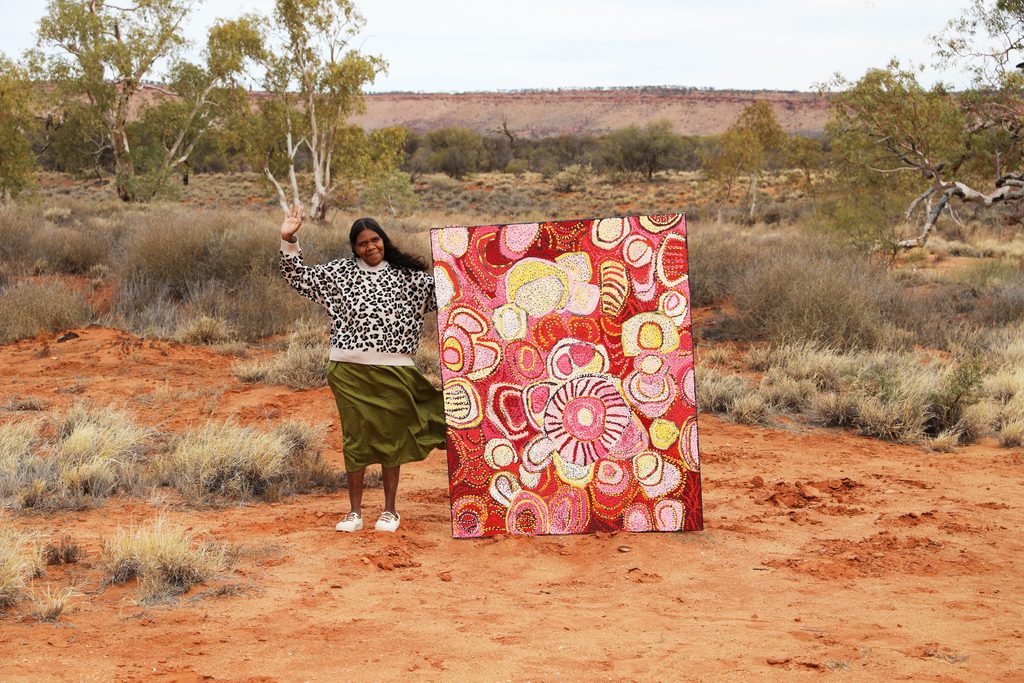
Above: Sallyanne Roberts on Country at Indulkana with her artwork. Courtesy: Iwantja arts.
When collectors purchase through an Art Centre, they know where the artwork has come from, who has created it and how the proceeds are distributed.
offering including digital programs, created forums, awards and runways, and strengthened our storytelling capacity so that artists and communities could speak directly to audiences nationally and internationally.
For collectors, this creates a unique opportunity. Acquiring Indigenous art is not solely about building a collection. It is about participating in a living cultural exchange — understanding the stories, histories, aspirations and contemporary realities that artists communicate through their work. Visitors frequently tell us that attending DAAF changes their perspective. They meet artists from some of the most remote communities in the world
and engage with cultures maintained and celebrated for more than 65,000 years. DAAF’s success demonstrates what is possible when artists and communities lead. It shows that ethical business and cultural integrity are not competing priorities; they are mutually reinforcing foundations for long-term success.
Twenty years on from that first gathering in a Darwin hotel ballroom, DAAF remains a place where collectors can engage confidently and ethically with some of the most important contemporary art being created anywhere in the world — while knowing they are part of ensuring our Aboriginal and Torres Strait Islander communities stay strong and celebrated.
